

Residential Park or Traditional Apartment Building? – What the difference actually means in everyday life
The demand for newly built residential parks has not only grown spectacularly over the past decade but has also significantly transformed in substance. Today, the appeal of modern residential parks goes far beyond aesthetic architectural solutions or modern technical equipment. Two key concepts are increasingly prominent behind buyer decisions: functionality and community quality of life.
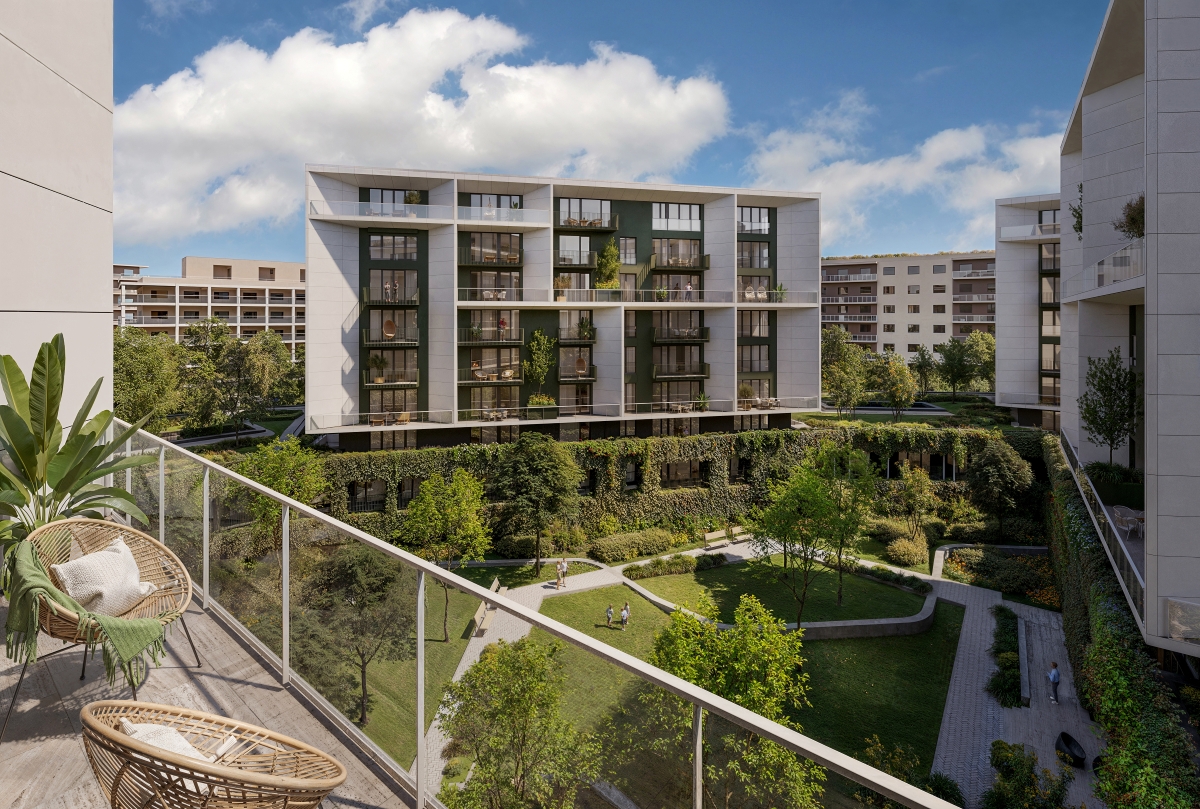
The role of modern residential parks in Budapest’s urban fabric
The eclecticism that fundamentally defines Budapest’s skyline has taken on a new meaning in recent years, as modern residential parks—visually striking from the outside and built at various frequented points across the city—are becoming an increasingly integral part of it. Naturally, these properties serve the ambition of providing residents with modern, livable housing that meets all 21st-century expectations, including criteria such as the increasingly mentioned 15-minute city concept.
Within the vast territory of Budapest, such a residential park forms a separate island that stands out from the crowd, even though numerous other building complexes and traditional apartment buildings can be found in the city. The basis for this distinction—alongside advanced technical content and unique architectural solutions—is primarily the environment of the residential parks, the consciously designed community spaces, and the resident-centric approach often emphasized by designers and developers alike, which will also define the concepts of the future. In this sense, a modern residential park is not an isolated unit but an independent micro-ecosystem that is organically connected to the urban infrastructure.
Differences in Perspective - How does a modern residential park compare to traditional apartment buildings?
The difference between modern residential parks and traditional apartment buildings cannot be interpreted solely on a technical or architectural level. It is much more a shift in mindset.
In the classic apartment building model, the focus was on the building itself, whereas in residential park developments, the starting point of design is the resident and their lifestyle. This change in perspective determines: the proportion and quality of community spaces, services within the building, the integration of green surfaces, and the long-term concept of management.
Metrodom residential parks – including Metrodom River – reflect this resident-centric approach, where proximity to nature, community usability, and livable interior spaces are not communication elements, but actually implemented functions.
What does proximity to nature mean for an urban residential park?
The term "close to nature" is one of the most used, and often overused, concepts in urban real estate development. It can only be filled with real substance if green surfaces are integrated consciously and systematically.
In Metrodom developments, this appears on several levels:
- as a locational advantage, for example, through direct proximity to the Danube (Metrodom River, Metrodom Beat),
- as an architectural solution, such as the vertical green surfaces of internal atriums,
- as an environmental approach, which serves to improve the microclimate and visual comfort.
In the case of Metrodom Green in the 9th District, vertical greening is not just an aesthetic element, but a tool for mitigating the urban heat island effect.
What is the buyer really looking for in a newly built property today?
Based on real estate market experience, the "apartment" as a product is no longer sufficient on its own. Buyers are looking for a complex quality of life, which includes a well-organized community environment, time-saving solutions, in-building services, and a concept that retains its value in the long term.
It has long been a trend in Western Europe that buyers seek service-focused buildings rather than just livable spaces, a trend that has now clearly appeared in Budapest, especially in developments close to the city center.
The role of functionality in value retention
Due to the faster-paced, often rushed lifestyle experienced in large cities like Budapest, residents of residential parks increasingly demand that upon returning home, services facilitating recreation, community building, and more are available locally—in short, the functionality of the buildings must be at a high level. Local availability saves them a significant amount of time and substantially increases the comfort and perceived standard of living of their residence.
These are not only important from a convenience perspective but have a direct impact on the property's market appeal, rentability, and value preservation.
A modern residential park is already designed in this spirit, and these extra functions are built in quite deliberately, thereby increasing the market value retention of the properties. The demand has already been officially recognized, as the domestic regulatory environment has moved in this direction—a clear sign of which is this year’s provision of the General Rules for Urban Planning and Building Requirements, thanks to which, in the future, only residential parks and apartment buildings that include community functions alongside the apartments can receive building permits.
Community as added value
When we talk about the community of a residential park, we are essentially talking about fairly large groups of people and families living truly side-by-side and with one another. Community spaces are not self-serving elements. When well-designed, they strengthen the residents' attachment, increase the sense of security, and result in a more stable residential community in the long run. Of course, residents play an active part in building the community, but consciously designed community spaces create orderly and modern conditions to achieve this, providing a firm foundation. In Metrodom residential parks, fitness rooms, community lounges, and multifunctional rooms all serve the purpose of allowing community life to develop naturally, without any pressure.
What kind of community spaces do we find in a residential park?
When designing the community spaces of Metrodom residential parks, the main goal was the aforementioned functionality and creating the opportunity for community building. Another important aspect is to save time for residents, which a fitness room serves, for example, as residents can perform their daily post-work workout locally and conveniently. Connection between residents is facilitated by rooms such as the community lounge, which can host smaller events and friendly gatherings, be it a match viewing, a birthday, or any other special or everyday occasion where members of the residential community have the opportunity to meet and form relationships.
How can the community experience manifest?
The community experience in modern residential parks can be caught on several fronts. First, naturally, in the aforementioned spaces and the functionality serving the residents' needs, but we can also mention a less material aspect. This is nothing other than the feeling of belonging to a community, the building of which was an undisguised goal during design and which these spaces absolutely support. If residents feel like part of a community, it provides a significant plus in many respects, whether we mention the general atmosphere, mood, or even the sense of security. We have seen examples of the power of community many times and in many places, so naturally, in the case of a Metrodom residential park, this represents the most decisive pillar.
For whom is the residential park lifestyle ideal?
The residential park lifestyle is primarily ideal for those who wish to live in an urban environment, value the presence of green surfaces, consider time efficiency important, and think long-term regarding property, whether for their own use or as an investment.
The extra services and the extra attention paid to the community are factors that, for the majority, are important components of a comfortable and slightly more carefree life. The nature-proximate, greener approach of Metrodom residential parks also supports a perceived escape from the city, creating a duality in which the bustle of the city and the tranquility of nature are both within reach, thereby creating a medium and community that can offer a true home for many.
Summary
Today, modern residential parks are not alternatives to, but enhanced versions of the traditional apartment building model. Metrodom residential parks are among the first on the domestic market to represent that complex perspective in which architecture, functionality, community, and environmental awareness form a unified system.
This is the approach that creates real homes – not just apartments, but livable urban living spaces.
FAQ
Where are Metrodom residential parks located in Budapest?
Metrodom's newest residential parks, some already completed and others still under construction, are located at three different yet frequented points of the city, in the 9th, 11th, and 13th districts.
Where can we search for available properties?
Both currently available apartments and those available for moving in soon can be viewed on the Metrodom website.
How can we find the right apartment?
With the help of the advanced apartment search engine on the Metrodom website, we can easily and quickly filter the options suitable for us, and with the help of marking favorites and comparison, we can compare the most important parameters in moments.
Which residential park is the most nature-proximate?
In terms of location, the Metrodom River and Metrodom Beat residential parks offer the most nature-proximate options, thanks to the proximity of the Danube. However, the more central location of Metrodom Green is compensated for by consciously planted vegetation and a green environment.
What rooms help with community building?
Each of the Metrodom residential parks offers different options regarding rooms for community building, among which you can find fitness rooms, community lounges, and multifunctional community spaces.